
Never Knowingly Undersold. This is a slogan that I’ve puzzled over for some time. If you weren’t already aware, it’s the John Lewis slogan and it’s fairly aggressively pushed, as if it’s of vital importance to the brand’s strength.
The thing is, I don’t see how it can be. For a start, exactly how many people know what this means? Never Knowingly Undersold. What is underselling? A soft sell? Like they don’t try to make you buy things too much?
“Never Knowingly…” is a bit of an ambiguous slogan too, isn’t it? It’s like a bit of a disclaimer: “Well, we didn’t knowingly dump all that depleted uranium on a nursery in Baghdad but as it transpired that’s what happened. Sorry.”
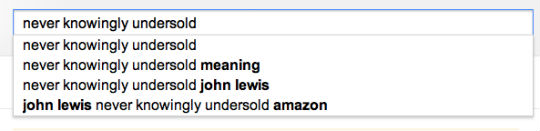
Never Knowingly Undersold. Just ponder those words and their meaning. There are two things – in isolation from John Lewis – that I might assume this meant. The key word is ‘undersold’. A derivation, I’d guess, of the verb ‘to undersell’.
What meaning might we attribute to this word? If you undersell yourself you don’t value yourself sufficiently – or promote yourself in line with your talent or ability. Is John Lewis suggesting that it doesn’t (knowingly) undervalue itself? Unlikely. So we can discount that line of reasoning.
Secondly, although I’ve never heard it used in this context, I’d hazard a guess that undersell might mean to undercut competitors. But is John Lewis really saying that it doesn’t (knowingly) sell its goods at a lower price than competitors? Again, this seems so unlikely as to be impossible.
So, what does it mean? I looked it up and, according to John Lewis, it means that John lewis will refund the difference if you see a lower price elsewhere for something you buy in the store. If you consider that ‘Never Knowingly Undersold’ is prefaced with an elliptical ‘We Are Never’ then it makes a kinda-of sense – if you’re aware of the rather archaic meaning of ‘undersold’.
But without this clarification it could actually appear that John Lewis is saying that its own goods are ‘Never Knowingly Undersold’ – the direct opposite meaning of the actual meaning. Assuming that anyone has got this far in the first place.
What this amounts to, then, is a slogan that is likely to baffle consumers or, even worse, make them believe that John Lewis is a really expensive place to buy their decorative bottles of olive oil with chilis in them.
The slogan used to refer to the John Lewis promise to refund the difference if shoppers found a cheaper price for goods bought in the store elsewhere, but even that isn’t true anymore – as of 2011 it will not offer a refund on products for which it provides a longer warranty than High Street rivals which, as it turns out, covers rather a lot of goods sold at John Lewis.
Underlining all of this is a survey from 2003 that found barely half of high-street shoppers could understand what the promise actually meant:
21% of respondents thought that it had the exact opposite meaning than the one intended, and that the company never purposefully charged lower prices than its competitors.
Nearly one-fifth thought that it meant that John Lewis never deliberately charged more than competitors.
The survey found that nine out of 10 people polled would not use the word “undersold” in common usage.
Can any of this add up to a strong marketing proposition? A largely misunderstood slogan that is rather fudged by small print?
Well, John Lewis certainly thinks so as it’s made the slogan the keynote of its latest ad. Of course, this being John Lewis, we’re legally obliged to blub whenever they come on our TVs and associated devices.
Perhaps the slogan works better in relation to these ads actually. These lengthy, mawkish ads have become the store’s stock-in-trade – whatever else you might think of them, they’re certainly not undersold.